What to see inside the Château des ducs de Bretagne
The courtyard and the white palace
Start here, because it is the one thing nobody warns you about. Outside, black granite blocks and courses of schist, a defensive wall built to be shot at. Inside, a fifteenth-century ducal residence in white tufa, flamboyant Gothic with Renaissance touches, with sixteenth- and eighteenth-century buildings around it. Anne de Bretagne added the loggias and the spire over the main stair tower. Two buildings, two moods, one gateway between them. You pay nothing to stand in the middle of it.
The rampart walk and the seven towers
The defences run to roughly 500 metres of curtain wall with seven towers, and you can walk the top of it. The named ones are the Tour du Fer-à-Cheval, the Tour des Jacobins, the Tour du Port, the Tour des Espagnols, the Tour du Pied-de-Biche, the Tour de la Boulangerie, the Tour de la Couronne d’Or and the Vieux Donjon. The Tour des Espagnols is the one with the story: on 17 July 1800 a rotten ceiling gave way onto the powder store below and the explosion killed around sixty people and wrecked part of the castle. That and the rest of the timeline are on the history page.
Walk the wall anticlockwise and finish above the gate. You get the black fortress on one side and the white palace on the other in the same view, which is the photograph everybody actually wants.
The museum: seven sequences, 32 rooms
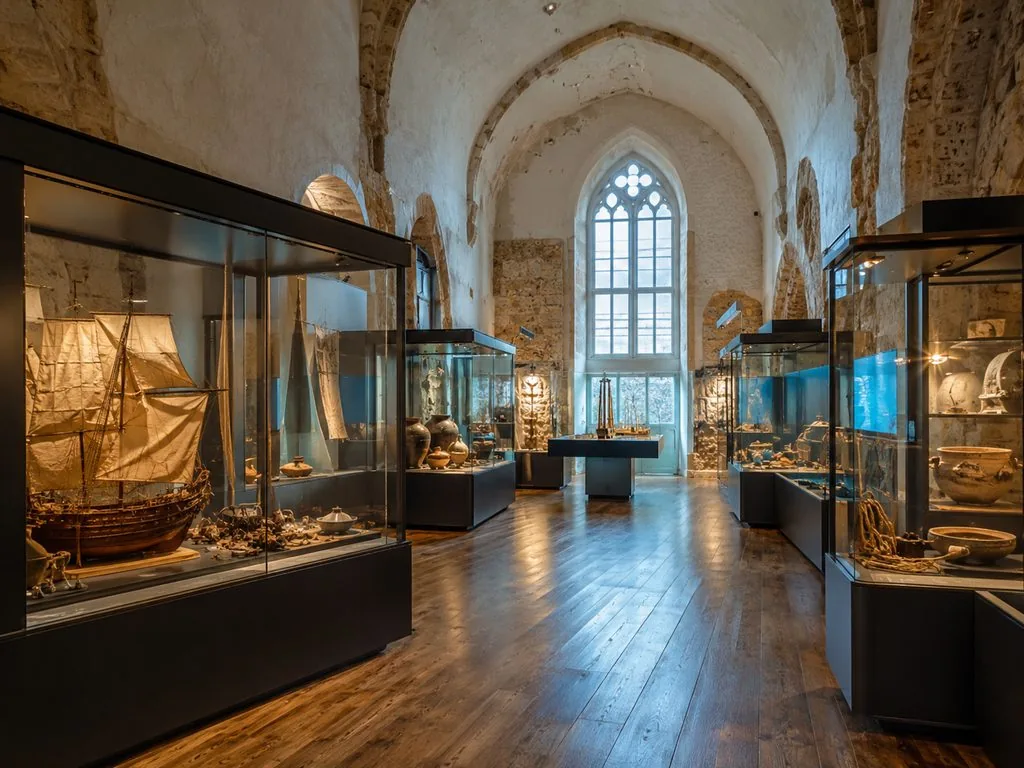
The Musée d’histoire de Nantes fills 32 rooms of the palace and tells the city in seven sequences with around 1,150 objects and a lot of interactive multimedia. It runs from the ducal city, through the Atlantic slave trade, into the industrial city, both world wars, and an extension covering 1945 to the present. Nantes was France’s largest slave-trading port and the museum does not soften that; those rooms are the reason to buy the ticket and they are the rooms people stand still in. The 1945-onwards extension is the weakest stretch, and I say so on is it worth visiting.
The temporary exhibition
The current one is Expression(s) décoloniale(s) #4, running from 8 May to 8 November 2026, and it is included in the same one-day museum ticket rather than charged separately. Who pays and who does not is set out on the tickets page.
The moat gardens
Outside the wall, open at 8am, free, and the part locals actually use. They are the best place to look up at the towers from below and the quietest corner of the site before the museum opens at 10am.
Seeing it with a guide
The licensed monumental tour is the one that goes inside as part of a wider route: 30 minutes in the château through a separate entrance, 10 minutes in La Psalette, 15 in the Cathédrale Saint-Pierre-et-Saint-Paul, then Bouffay, the Basilique Saint-Nicolas and Place Royale, with the duchy, the Revolution and Jules Verne’s baptism church along the way. It sits mid-range among the five and rates 5.0, but from only three reviews, so read that score for what it is. The alternatives are laid out on the ways to visit page.
Frequently asked questions
What is inside the Château des ducs de Bretagne?
A courtyard with a white tufa flamboyant-Gothic ducal palace, a 500-metre rampart walk over seven towers, moat gardens, and the Musée d’histoire de Nantes: 32 rooms, 7 sequences and around 1,150 objects.
What does the museum cover?
Nantes from the ducal city through the Atlantic slave trade, the industrial city, both world wars and an extension on 1945 to the present. Nantes was France’s largest slave-trading port and the museum does not soften it.
Can you walk the ramparts?
Yes, all 500 metres of curtain wall, seven towers, free, seven days a week from 8:30am. Check the opening hours, because last entry is 15 minutes before closing.
Is there a temporary exhibition?
Expression(s) décoloniale(s) #4 runs from 8 May to 8 November 2026 and is included in the museum ticket rather than charged separately, as the ways to visit page explains.